After AGI: We Need Humanism More Than Intelligence
Humanistic Intelligence for Changing Lives and Shared Futures
Question & contribution
When AI helps shape what people want, what should remain possible for them and for those who come after?
A humanistic account of new purposes, participation, care, and revisable inheritance: what intelligence carries forward includes people's capacity to reshape a practice, alongside its outputs.
Evidence in this release
Developed arguments and difficult cases, with finite computational diagnostics reported separately. The normative argument does not claim an empirically established algorithmic or human-benefit advantage.
Human lives
Care, resonance, rest and creation
Purposes & shared practice
People and AI open new pursuits
Possibilities for successors
Inheritance can be understood, changed or set aside
A guide to the normative argument, not a measured human benefit.
Abstract
Advanced intelligence can help people encounter new possibilities, form purposes, create together, earn a living, and receive care. When AI helps shape physical and virtual activity, learning from a successful experience also shapes what people can do next. Liva.Taihe argues that useful capabilities can warrant continuation while their originating purposes, assignments, and cultural forms require distinct, connected judgments. Shared responsibilities may justify continuity; a person's standing never depends on productivity. Truth and love join concern for particular lives to answerable inquiry. Lingji and rationality support both new questions and their examination, while rest and familiar commitments remain legitimate ends. A constructed theatre undertaking connects an unexpected encounter to a new purpose, an editable practice, and later people's different works. Even unanimous agreement to present automation can leave successors unable to adapt what is inherited. Comparing recordings, executable handovers, alternative services, and maintained practices exposes the enabling conditions and costs that can reverse the recommendation. Drawing on capability, care, and autonomy accounts, the contribution is a normative design synthesis connecting learning, delegation, and transmission. World models, persistent agents, editable world production, and recursive improvement are candidate means for present and conditional post-AGI worlds. Local technical diagnostics establish no algorithmic advantage; participant and civilizational benefits remain untested.
Architecture & figures
Humanistic reasons and the place of technology
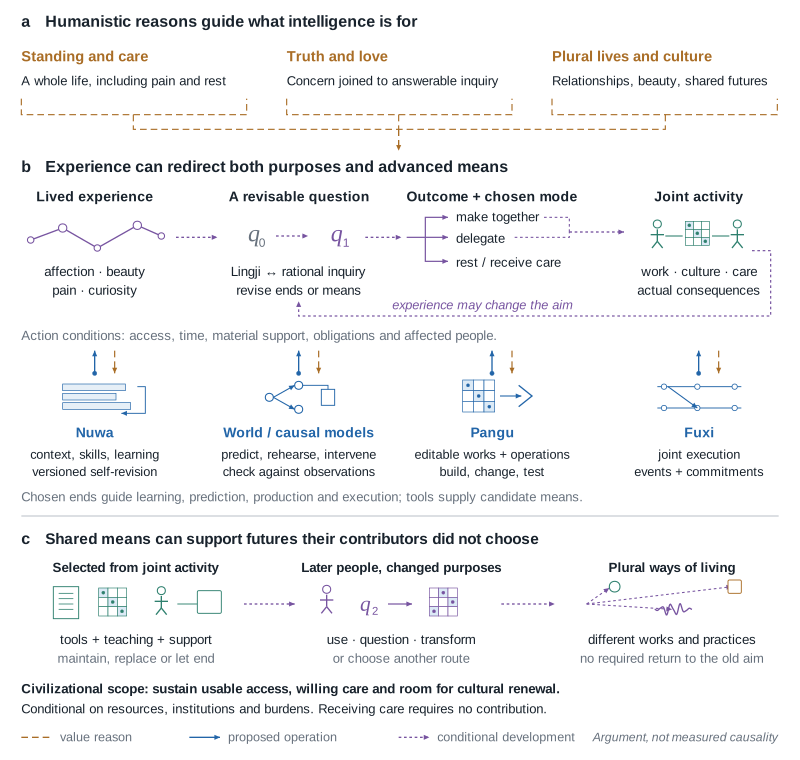
Humanistic reasons, advanced means, and shared futures
Purpose formation and successor making
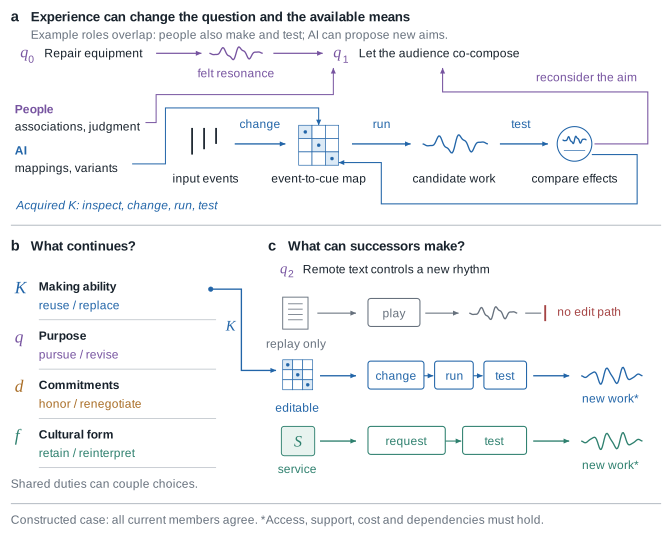
Purpose formation and successor making
Research materials
Computational evidence · code, protocols, recorded results
Artifacts are versioned and retain limitations and failures. See the notices included with each package for reuse terms.
Suggested citation
@misc{liu2026livataihe,
  author = {Liu, Huaiyang},
  title = {After {AGI}: We Need Humanism More Than Intelligence},
  year = {2026},
  month = nov,
  note = {Liva.Taihe. Humanistic Intelligence for Changing Lives and Shared Futures. Preprint. DeepBean Limited}
}