Creating Worlds in Use
Situated World Production with Revisable Creative Decisions
Question & contribution
How can making, playing, and revising happen together—and how can a creative decision change the next work?
A production framework connecting editable worlds, revisable creative relations, current-work binding, and continued use. Its full remit spans reconstruction, geometry, materials, bodies, behavior, and presentation.
Evidence in this release
Authored relation changes alter subsequent works. A real-model development batch records candidate update failure and one of two strong-agent works passing the task checks. Production-learning superiority and broad coverage remain unestablished.
Creative choices & reasons
What should change, and why
Relations & the current work
Bind applicable relations to the current source
Production, use & revision
Use informs the next creative decision
Production framework; general source binding is proposed, and generation or learning gains remain unestablished.
Abstract
World creation continues as people play, work, and revise what they want to make. AI production must connect those decisions to changes in geometry, appearance, bodies, actions, and rules while sustaining ongoing use. We introduce Pangu, a framework for situated world production whose central system object is a revisable production commitment: a relationship supported by creative experience, qualified by its scope, and applied to an identified subsequent work. The architecture connects editable production, local decisions, current-state installation, and the proposed improvement of later production. A restricted reference turns authored choices and explicit revisions into different subsequent stage arrangements that remain operable. This establishes a concrete link from changing decisions to later works within an authored finite relation library. A reason-sensitive development pair then tests real model interpretation and production with shared tools. The candidate fails initial update admission, leaving both production opportunities unexecuted; a full-history agent produces one usable work and one rejected work. Its memories select different relation labels for different reasons, but one final program fails to apply the selected relation to the new source. These results distinguish semantic selection, interface admission, source binding, and actual use. They support a limited executable system formulation, not a production-learning advantage. We specify a source-bound application path that keeps historical coordinates separate from current-work operands; its incremental benefit, broad production coverage, and creator value remain to be established.
Architecture & figures
World production in use
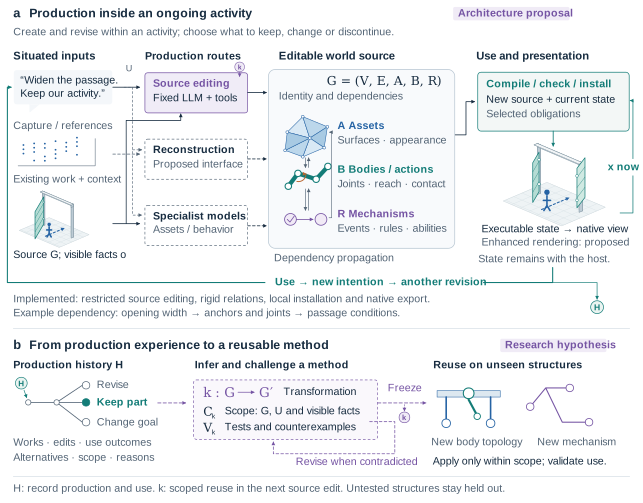
Proposed full production architecture. Situated intent U and source G connect assets A, bodies/actions B and mechanisms R through identities V and dependencies E. These links express constraints and revision propagation, not a demonstrated joint learned model. Installation uses current activity state x. History H, transformations k, applicability C_k and checks V_k depict the proposed learning route. Section 3 distinguishes a revisable commitment c from its current-source binding b; k is the broader transformation, not a claim that general binding or learning is implemented. Reconstruction, rich bodies, enhanced rendering and learning advantage remain unvalidated. The scenes are schematic.
Structural production: outcomes and unmet requirements
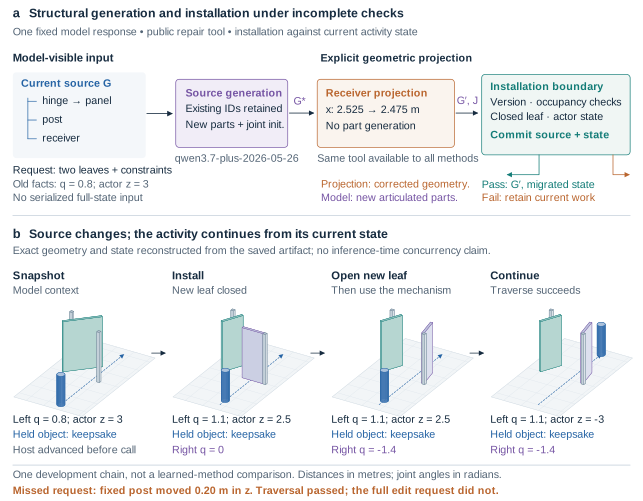
Earlier structural-production evidence, separate from the reason-sensitive study. The fixed model creates a second articulated leaf; a public tool corrects receiver geometry; current-state installation permits the recorded subsequent traversal. The original request also required a fixed post, but changing width displaced it by 0.20 m along z. The full edit request therefore failed despite passing the then-used checks. Four views are reconstructed from saved source and state. The host advances before the model call; inference-time concurrency is not measured. This is neither a learned-method comparison nor evidence for the proposed general binding layer.
Research materials
Synthetic research evidence and real-model development records
Artifacts are versioned and retain limitations and failures. See the notices included with each package for reuse terms.
Suggested citation
@techreport{liu2026pangu,
  author      = {Liu, Huaiyang},
  title       = {Pangu: Creating Worlds in Use --- Situated World Production with Revisable Creative Decisions},
  institution = {DeepBean Limited},
  year        = {2026},
  month       = nov,
  number      = {Version 1.0},
  type        = {Research preprint},
  url         = {https://liva.land/arXiv/},
  note        = {Not peer-reviewed by a journal or conference. No DOI or arXiv identifier assigned in this release.}
}