Shaping AI Through Shared Life
A Framework for Human-Authored Agency
Question & contribution
How can people actively shape an AI that represents them, while shared experience opens up new interests and capabilities?
A framework connecting self-authorship, situated representation, shared works, and subsequent action. People can change what the AI should represent rather than being reduced to a fixed inferred profile.
Evidence in this release
Executable synthetic shared-creation samples and a real-model development study, with authored components and interface failures identified. Durable learning gains and long-term personal benefit remain unestablished.
Self-authorship & shared life
People choose how AI represents them
Revisable personal understanding
Experience informs proposals; correction remains possible
Next actions & shared works
Updates should affect subsequent participation
Proposed research path; local samples do not establish a learning advantage.
Abstract
People should be able to shape an AI through deliberate choices about how they wish to be represented and what they hope to become, alongside evidence of their past experiences. We introduce Liva.Nuwa, a framework for AI companions and delegates shaped through continuing shared activity. A person contributes experiences, reasons, works and revisions; the agent uses them to offer practical and emotional support, act on delegated purposes, and create with people and other agents. Resulting works and observed consequences provide evidence for revising understanding and reusable capabilities, while interests and relationships remain open to further development. The central hypothesis is that this combination can reduce everyday burdens and expand what people and agents can do together. Chosen direction remains distinct from inferred habit, aspiration from demonstrated ability, and proposed action from accomplished fact. We specify a multimodal life architecture, an executable partial substrate and comparisons against same-information agents. A synthetic creation sample establishes actual artifact reuse, with researcher-supplied updates. A real-model development study stopped after 33 of 36 planned calls; output-contract and semantic failures prevent attribution of a learning advantage. A separately frozen, unexecuted protocol replaces supplied updates with model-produced interpretations and programs, comparing their later use against a general agent with the same tools and budget. The contribution is a concrete system research object and partial realization, supported by diagnostic and negative evidence. Superior learning, reduced human burden and sustained relationship growth remain hypotheses.
Architecture & figures
From shared life to subsequent participation
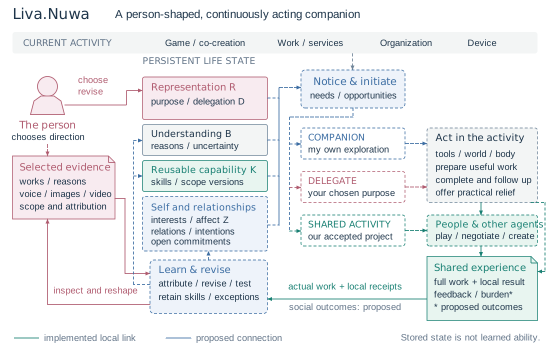
Proposed full life architecture with narrower implemented links explicitly marked
Local update and action paths
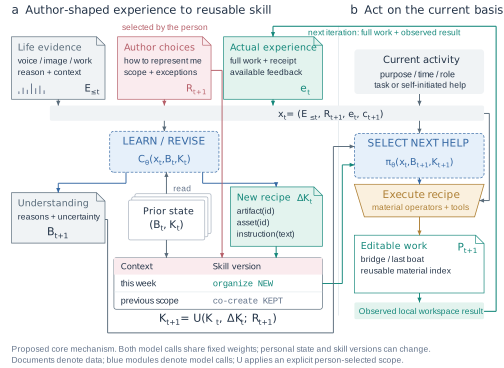
Local update/action paths; no established semantic learning benefit
Research materials
Research artifacts and recorded development study
Artifacts are versioned and retain limitations and failures. See the notices included with each package for reuse terms.
Suggested citation
@unpublished{liu2026livanuwa,
  author = {Liu, Huaiyang},
  title = {{Liva.Nuwa}: Shaping {AI} Through Shared Life},
  year = {2026},
  month = nov,
  institution = {DeepBean Limited},
  note = {Research framework and development studies, version 1.4-rc1}
}