Worlds Change, Consequences Continue
Runtime Semantics for Growing Worlds and Unfinished Commitments
Question & contribution
How can a changing world retain the consequences of earlier actions while its rules, capabilities, and commitments evolve?
A runtime formulation binding earlier effects, current mechanisms, and accepted commitments, with recorded authorized revision. Reference implementations make continuation and its failure conditions inspectable.
Evidence in this release
Finite models, HTTP execution records, and host-adaptation studies support the system formulation. Strong controls match key results; independent speed or learning superiority is not established.
Actions already taken
Events emitted; obligations still open
Mechanisms change in use
New rules enter the same activity
Consequences & commitments
Facts, versions and receipts remain traceable
A guide to runtime semantics, not a fully deployed distributed system.
Abstract
A shared world must keep unfolding as people and agents change what it contains and how it works. Earlier actions may still be producing effects, objects and activities may be added, and accepted commitments may remain unfinished. We present Liva.Fuxi, a runtime architecture and reference implementation for continuing such worlds through change. Its interfaces distinguish three bindings: emitted effects retain their original content and provenance; receiving objects respond under their current mechanisms; and accepted commitments retain their subjects, agreed terms, and monitor histories. Changes to goals or deadlines require explicitly authorized, recorded revisions. Continuation does not guarantee that every commitment remains achievable. The architecture connects these semantics to object interactions, causal cascades, A2A collaboration, execution, and recovery, while separating prediction from authoritative outcomes. A complete local activity combines in-flight heat, material and activity edits, continued growth during client absence, installation and use of a predefined instrument, and actual fulfillment receipts. We realize this activity through both a resumable declaration compiler and an adapter to an existing handwritten world engine. Across eight requests per method, each fulfills all sixteen original obligations and completes two new activities; six unsafe, stale, or deliberately mismapped requests remain uncompleted expansions. The equally informed implementations have matched activity outcomes. Separate fixed-rule partition-recovery and observation-adapter studies support additional parts of the architecture, without establishing an integrated distributed or physical deployment. The contribution is explicit runtime interfaces and a reproducible system account of world growth with continuing consequences and commitments; independent productivity, scalability, learning, and participant-value gains remain to be established.
Architecture & figures
Consequences across mechanism changes
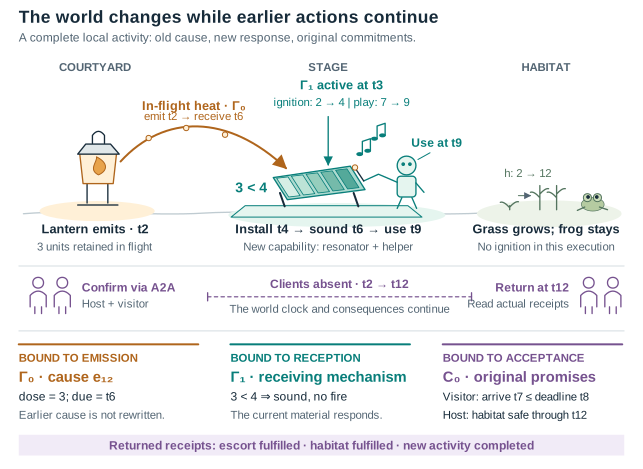
Earlier emitted facts, current receiving mechanisms and original participant commitments continue within one activity.
World runtime architecture
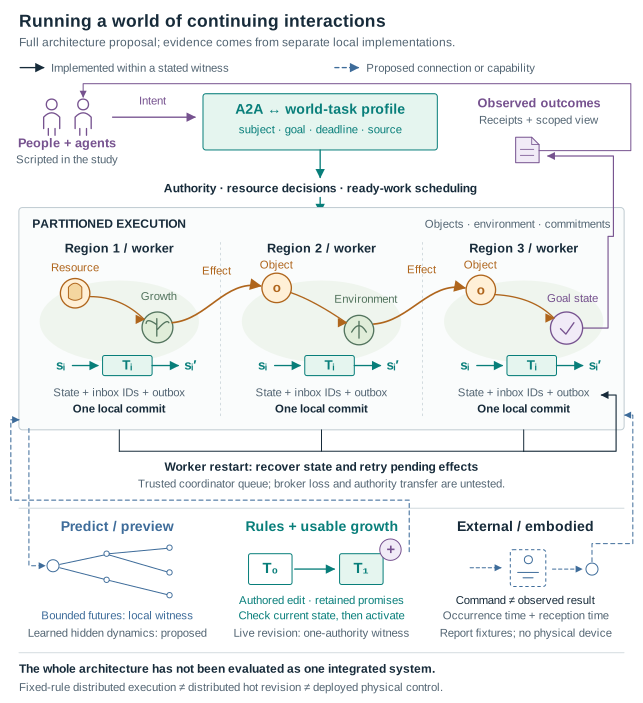
The full runtime architecture distinguishes implemented evidence scopes from proposed distributed and learned capabilities.
Research materials
Supplementary methods and evidence
Evidence archive · code, protocols, recorded results
Artifacts are versioned and retain limitations and failures. See the notices included with each package for reuse terms.
Suggested citation
@techreport{liu2026fuxi,
  author = {Liu, Huaiyang},
  title = {{Liva.Fuxi}: Worlds Change, Consequences Continue: Runtime Semantics for Growing Worlds and Unfinished Commitments},
  institution = {DeepBean Limited},
  year = {2026},
  month = nov,
  type = {Research paper}
}